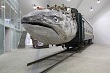
German hydrogen train network runs dry
electrive.com skrev:Germany has the first fleet of hydrogen-powered trains in the world. Too bad the operator is missing one essential thing to keep them running - hydrogen fuel. It is still uncertain when operations will go back to normal.
Because of delivery bottlenecks, the hydrogen train in the German state of Lower Saxony cannot operate as planned. Instead, five diesel trains currently service the line, while the hydrogen trains are shorter than usual to conserve fuel.
[...]
The 14 hydrogen-powered Coradia iLint regional trains replaced 15 diesel trains in 2022, servicing the routes between the cities of Cuxhaven, Bremerhaven, Bremervörde and Buxtehud. They are operated by the Eisenbahnen und Verkehrsbetriebe Elbe-Weser (evb) on behalf of the public transport operator Landesnahverkehrsgesellschaft Niedersachsen (LNVG). The operator says that it is the world’s first hydrogen train network.
Ja, Tyskland satsade tidigt på Coradia iLint. Problemet är dock att dessa tåg behöver exotisk
vätgas. Detta påminner en del om
Sandvikens vätgasbussar...
 The world’s first hydrogen-powered train has made its final stop
Popular Science skrev:Germany’s state-owned, $85 million hydrogen fuel-cell powered train system is shuttering almost exactly one year after its first public debute in August 2022. This doesn’t mean that the railways are reverting back to pollutant-spewing diesel engines, however. According to the country’s Ministry for Economic Affairs, Transport, Building and Digitisation, the lines will transition to electric battery-driven systems that are simply “cheaper to operate.”
[...]
At the time of its official rollout in August 2022, Stephan Weil, Minister-President of Lower Saxony, declared the project to be a “role model worldwide [and] an excellent example of a successful transformation made in Lower Saxony.” Weil added that, “As a country of renewable energies, we are thus setting a milestone on the way to climate neutrality in the transport sector.” By the end of the year, however, a state-commissioned study determined that hydrogen trains could be as much as 80 percent more expensive than other electric options. Last week, LVNG finally pulled the plug on its hydrogen fuel-cell plans.
Germany is still moving aggressively to address these issues while also attempting to maintain its goal to phase out all diesel trains by 2037. By decade’s end, for example, Lower Saxony officials plan to introduce 102 battery-electric trains alongside another 27 lines powered by catenary systems—overhead electricity lines that allow for constant power.
Satsningen på bränslecelldrivna tåg handlade egentligen om att pumpa in skattepengar i gasleverantören Linde. Stadlers Flirt Akku har en räckvidd på
150 km:
Railway Gazette International skrev:The first of the Stadler Flirt Akku battery-electric multiple-units ordered by Schleswig-Holstein transport authority NAH.SH have entered revenue service with operator Erixx Holstein.
[...]
Regular BEMU services began on route RB76 between Kiel and Kiel-Oppendorf on October 1, followed by Kiel – Lübeck – Lüneburg from October 22. BEMUs are to be introduced on the Büsum – Heide route from the December timetable change, and all 55 units are scheduled to enter service by mid-2024. Erixx will operate 26 of them.
[...]
The batteries are charged when the trains are operating on sections of route with 15 kV 16·7 Hz electrification and at stations fitted with overhead catenary. DB Netz is spending €40m to install electrification ‘islands’ totalling 11 km on selected routes by December, which will reduce the longest unelectrified gaps to less than 80 km.
Således finns det inget behov av bränslecelldrivna tåg i Europa. Den tyska industrin kan subventioneras direkt istället för att parasitera på kollektivtrafiken.